After several busy and exciting days in London, on May 19 Garnet Singers took a morning train to Cambridge. In just an hour’s time the busy city gave way to rolling fields and beautiful pastures.

View from the train to Cambridge (photo by Nathan) [A lush green field with a large group of sheep grazing and a wooded area in the background]
Even with the calmer scenery the group still had a busy itinerary! Silja ’28 writes about the experience of our first day in Cambridge:
While in the U.K., we had the opportunity to participate in two Evensong services, which are not as popular of a tradition in the United States. Many of us in Garnet are also less familiar with that style of sacred music, in which the choir responds to the person leading the service. This meant that aside from reviewing our music from the last two semesters, we also had to learn a whole new type of singing. Although this was definitely daunting–the musical notation and display of lyrics was also different–we had lots of help from the choral director at Jesus College in Cambridge, as well as the choir at Selwyn College. On Tuesday, we had a workshop at Jesus College and were able to learn about what might be expected of us during the service. On our last night in the U.K., we were able to observe an Evensong service at Jesus College, and see how what their director taught us translated into his work with his own choir. It was a phenomenal performance, and it was especially cool to see how there was a mix of university students and young children in the choir, all with the same attention to detail.
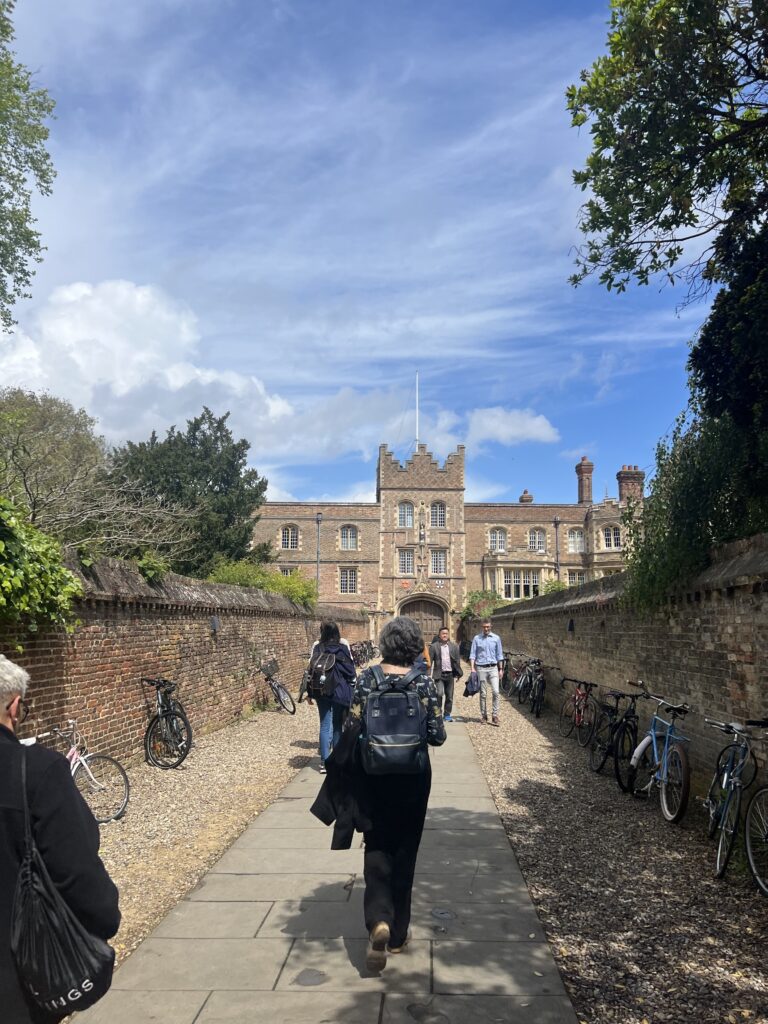
Approaching Jesus College, Cambridge (photo by Hsiao-Han) [Members of Garnet Singers walk down a walled pathway dotted with bicycles, approaching a large stone building in the distance]
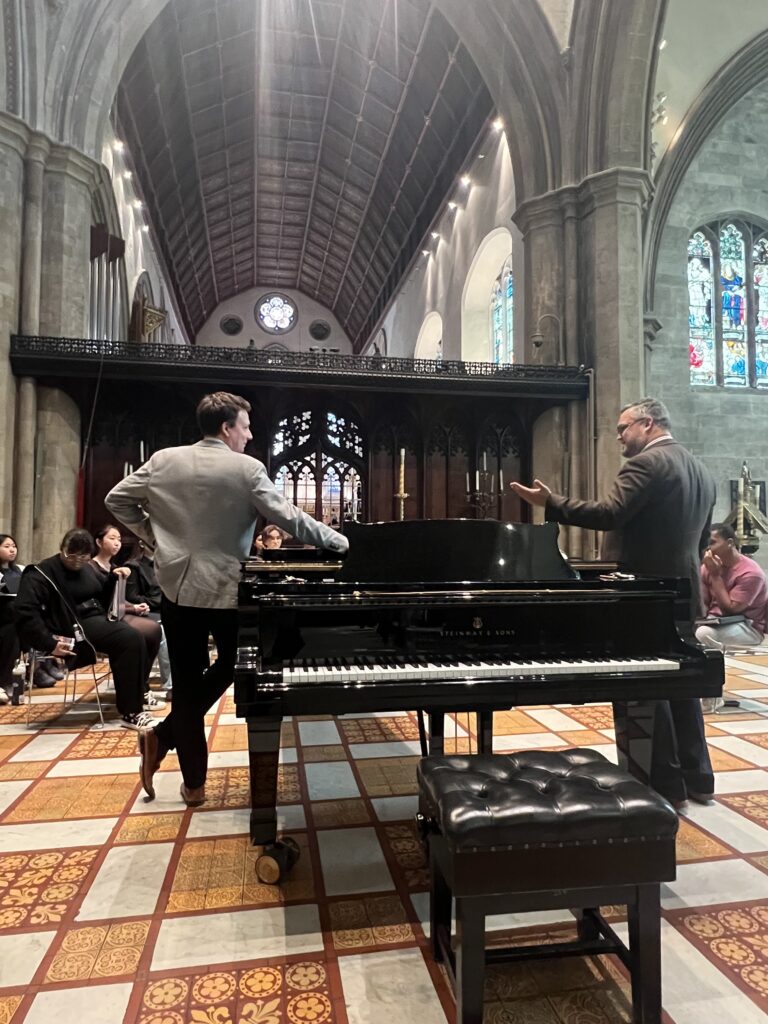
Participating in a workshop with Benjamin Sheen, Director of Music at Jesus College (photo by Hsiao-Han) [Garnet Singers sitting in a large chapel with a piano, facing directors Nathan Reiff and Benjamin Sheen, who are talking to one another]

Members of Garnet Singers in the beautiful chapel of Jesus College (dating to the 12th century!) (photo by Colette) [Four members of Garnet Singers standing in between two sets of wooden pews in an ornate chapel, with tall stained glass windows behind them]
After our workshop, we walked over to Selwyn College, where we were to sing in their own Evensong service. We participated in a fast-paced rehearsal with their director, which was especially engaging as we were practically sight-reading part of the program. Her students, however, must do this several times a week, and although they had seen this repertoire before, they often only get a brief rehearsal to learn it before the performance. This was incredibly impressive, as any musician will know, and this encouraged me to continue to improve my sight-reading skills. It was also so helpful to have the support of the other students during the service. The students standing next to me in the Selwyn choir directed me on how to stand, where to face, and the order of the music. This made our second Evensong, which we sang alone the following day at Ely Cathedral, much easier.

Colette in a courtyard at Selwyn College, Cambridge, with the chapel in the background (photo by Silja) [A person posing on a patio area in front of a large lawn with several ivy-covered brick buildings in the background; to one side is a large, ornate brick chapel]

Garnet Singers admiring Selwyn College on the way to Evensong at the chapel (photo by Nathan) [Members of Garnet Singers wearing formal attire and walking through the courtyard at Selwyn College, with brick buildings surrounding]
Aside from the unfamiliar style of sacred music, this trip also allowed me to make connections with singers from across the globe. Not only do embedded study trips help to expose us to different musical practices and give us performance opportunities, but they also foster cross-cultural communication and connections that go beyond the performances. Through participating in the Evensong service, I, alongside several others, were able to meet and spend time chatting with singers at Cambridge, which led us all to spend time together later in the trip. We spoke about music, our lives, our schools, and the different systems in the U.K. and the U.S. Alongside new choral skills, these human experiences helped to solidify this trip as an invaluable part of my education at Swarthmore, and I hope Garnet Singers continues to have opportunities like this to connect with other choral traditions and cultures.
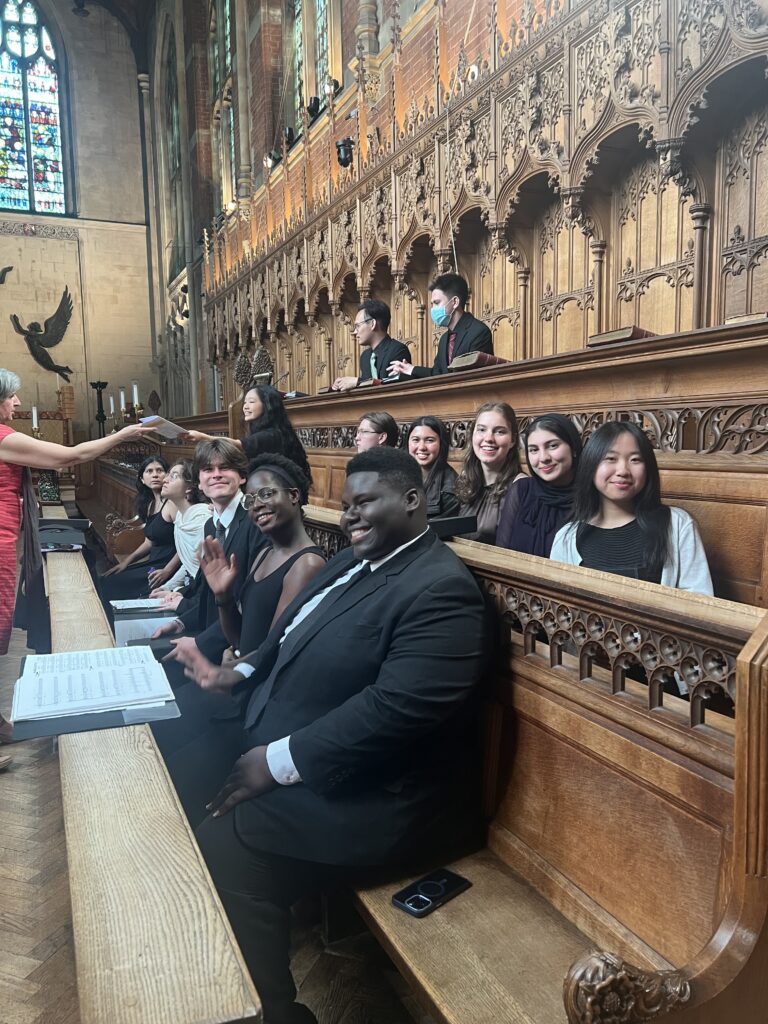


L-R: 1) Garnet Singers sitting in the pews at Selwyn College Chapel before rehearsal; 2) Garnet Singers and the Selwyn College Choir rehearsing; 3) After the Evensong service, the choirs had more time to chat and connect before a shared dinner (photos by Hsiao-Han, Pat, and Colette) [1) Several members of Garnet Singers sitting on wooden pews in front of an intricately carved wooden wall in the chapel; 2) The combined choirs in several pews facing each other to sing, with Sarah MacDonald, Director of Music at Selwyn College, in between to lead; 3) Members of both choirs gathered in a vestibule in small groups to talk]
Michelle ’28 also writes about the experience at Selwyn College:
Swarthmore music is so tight-knit that getting to work with a different set of musicians is a pretty rare and special opportunity. Rarer yet is being invited not only to learn from them, but to perform alongside them, even in a tradition to which you are a complete novice.
The Garnet Singers were lucky enough to be invited to meet the Chapel Choir of Selwyn College at Cambridge University. I feel so grateful to have been a guest in their space—and what a space it was. England is so old, and its architecture is so incredibly beautiful! In retrospect, it’s very serendipitous that visiting another university and collaborating with its choir doubled as sightseeing for us, because what do you mean the Selwyn College chapel is the youngest at Cambridge because it was built in the 13th century? I have to admit that much of the time we spent being briefed on the nature of the services we were going to sing or the history of the college went over my head because I was too busy staring at the gorgeously painted ceiling.
I shouldn’t worry too much about being momentarily distracted, though, because our visit to Cambridge turned out to be a tremendous learning experience. Here’s the thing: as singers, we rarely practice our sight reading. Voice (in my humble opinion) is one of the easiest forms of music to learn by ear, which is an important and useful aspect of musicianship to build!
However, that musical intuition doesn’t take you very far when singing chapel music. For the uninitiated (as I was, at the beginning of this process), in the Anglican church, Evensongs are highly structured, short, frequent services that take place in the late afternoon. The choristers (that was us!) sing various settings of the same texts every time. Because there’s no variation in the words, the music tends to be quite dense and fast-paced, without a lot of repetition for your brain to hang on to. In short, sight-singing is completely essential.
I felt like I was using my instrumentalist brain far more than my vocalist brain, and even then, I had a tough time. Sight-reading as a pianist, for instance, is mostly about locating notes are on the keyboard: it’s mostly about hand-eye coordination. A singer, on the other hand, needs to hear what they see and sing what they hear: having a working knowledge of intervals is super crucial.
Just to sightsing—to parse the notes and rhythms—is hard enough, but to sight-sing well, you also need to understand how your part fits in with the others: unity of tone and musical instinct is really important in homophonic four-part choral music that’s foundational to chapel singing. And unfortunately, you don’t always get to talk out the music with a director before you perform it; sometimes you have to develop that ensemble sense as you’re hearing the music come out of your mouths.
Jesus College Choral Director Benjamin Sheen put it well when he told us singers need to not only think horizontally—about our own lines—but vertically—about the greater context of the music you’re singing. That can mean listening out for patterns: places where your part echoes others. It can mean finding where your part has a different rhythm or an unusual note and leaning into it. It can also mean listening out for the greater chord progression and making sure that your phrasing suits where you are relative to the musical resolution.
These principles are true of all music, but it was something we got to hone in on with a laser focus through chapel singing, which ended up serving as a remarkable growth opportunity for me.

Garnet Singers outside of Selwyn College Chapel after a successful Evensong service (photo by Nathan) [A large group of singers posing outside of the front entrance to the chapel, with a large and elaborate doorway behind]
After a busy day with the workshop and the flurry of the Evensong service, Garnet Singers were very fortunate to join the Selwyn College Choir at the college’s Formal Hall, a traditional sit-down dinner with students and faculty. It was a wonderful chance to relax a bit and continue to connect with new friends and we were so grateful for their generosity and time, especially in the midst of finals season! Though no photos were allowed during Formal Hall, needless to say it lived up to the Harry Potter-esque hype in every way.
Leave a Reply