Arpi ’28 writes about our experiencing observing The Bach Choir in one of their final rehearsals of J.S. Bach’s B Minor Mass:
Although this commitment was rather passive on our part, observing the Bach Choir’s rehearsal with David Hill made a very strong impression. I hadn’t known what exactly to expect, but much of the other choral singing we’d seen so far in the UK involved smaller groups, perhaps 20-30 people maximum. That’s not to say they weren’t talented or powerful; the ORA Singers, for example, packed an incredible punch with their program. However, hearing the hundreds of voices in the Bach Choir sing together was a reminder of the community significance that singing has held throughout time. There’s a tremendous musical advantage to having large groups of singers, but great numbers also create opportunities for people to connect and form influential and meaningful relationships. Music performance used to be something that was shared by everyone, whether in religious traditions or simply in people gathering around a piano and playing or singing together. Nowadays, I think it’s much rarer for people to find spontaneous or casual connection via music, which is a great loss for society.
The Bach Choir didn’t only make an impression on me because of its size. Their ways of conducting rehearsal and their skill level were also pretty unusual. Technically, having such a large number of people singing each part allows for more leeway in things like where to breathe, or what register each individual is using for a particular part because the aggregate sound can still come out solid. However, that mentality wasn’t in effect here. It was clear that there was unity and agreement within each section and among sections on what principles would be used throughout their performance, which allowed for uniform and cohesive sound. Part of that probably comes from the instincts and experiences of the singers, since this is an auditioned choir. However, I believe their overall sound and excellent is greatly shaped by their conductor/musical director David Hill. Watching him in rehearsal was like a masterclass.

David Hill, conductor of The Bach Choir, welcomes Garnet Singers to rehearsal before they begin (photo by Pat) [A group of people sit on a balcony overlooking a large area with rows of singers seated in chairs; at the front of the balcony is a person gesturing while describing the rehearsal]
I like to practice capoeira, and one of the hallmarks of a true mestre (or master) in that sport is the absolute efficiency with which one plays. A mestre doesn’t need to play in a dramatic or flashy way, and often one might watch them and assume that their smaller steps and motions indicate a lack of ability or courage to engage with their opponent. However, such practices are truly ways to conserve energy and observe others, allowing them to move with sudden swiftness and demonstrate (or perhaps even fully throw) a move which would completely disarm their partner. This is what David Hill’s conducting put in my mind. He didn’t conduct every beat of the music. He would cue entrances and dynamic changes, sometimes seemingly just sitting on his stool without paying any attention to the choir. However, when he called them to a stop, I realized that he was using that time to listen. He caught and concentrated on small details, like the clarity of a four-measure run in the alto line or the interplay of entrances between different parts. Once he made his changes, though, I didn’t see those details as small anymore. His attentiveness brought out different themes or moods in the music which made me think, “Wow, that must be how Bach intended it to be sung in the first place.” That was my thought through most the of the rehearsal to be honest, because of the size, strength, and focus of the choir.
After watching that rehearsal, I felt a strong desire to interrogate the ways I sing in groups. Although there aren’t many groups like the Bach Choir which are both massive and high-level, that doesn’t mean that the same principles of unity of focus, attentiveness to others in both your part and others, and desire to elevate rehearsals beyond simple corrections cannot be applied elsewhere. I hope that I can bring them to bear in my own singing, and maybe even use them to improve groups I participate in.
Michelle ’28 also wrote about the experience:
In my two-ish years participating in Swarthmore’s Music Department, I’ve never run out of things to do. I take private piano lessons; I sing in vocal ensembles, both co-curricular (like Garnet) and extra-curricular (e.g. my beloved Offbeat a cappella); I compose music, sometimes with my peers; I take classes in the department, some of which, like Film Music, intersect with my own major. The list goes on. I more often find myself regretting that I can’t commit more than I already do. (Fetter, I’ve got my eye on you. One of these days, it’s gonna happen.) In my (perhaps biased) opinion, music is a juggernaut of Swarthmore’s academic offerings: we even get our own building, after all! It can especially feel that way in the context of Swarthmore’s small student body (only 1700 students).
Before I hopped on our flight to the U.K., then, I had forgotten that we are, in fact, tiny. Cozy, for sure! Intimate! But tiny.
Cut to a week later. My buddy and I got lost on our way there, but, as instructed, we eventually make our way to the Westminster Cathedral Hall, where the group rehearses. We realize we’re in the right place when we start hearing Kyrie!s with perfect clarity through the wall of solid brick.
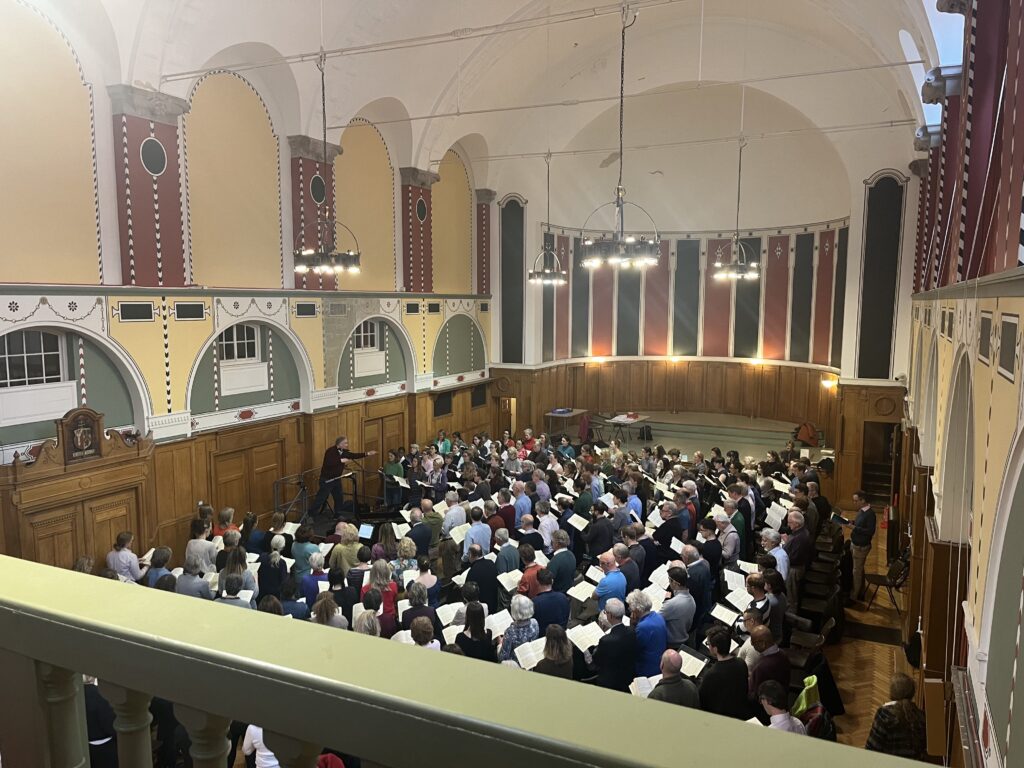
The Bach Choir in rehearsal (photo by Nathan) [A large group of about 200 singers fit snugly into a sizable room, spaced out in many rows, and all facing the conductor, who is standing on a sizable podium]
Even now, the scale is hard to describe. We had been told that the Bach Choir was about 200 voices strong. Take a minute to think about that. That’s crazy. One class year at Swarthmore is about 400 people. Imagine doing half of First Collection, once a week, every week, for 2 hours straight. Also, they’re all in one room and they’re singing at a full fortissimo. You start to worry that your face is going to melt from the sound.
I know from experience that singing in a group that large is entirely different from what it’s like performing in a chamber choir like ours. So much of singing is about space: where you are, the air that your voice resonates through, your posture, the way you carry yourself. In a large group, your individual timbre very quickly dissolves into the larger texture. What does come through are things like phrasing, breaths, and consonants like your s’s and t’s.
The same thing applies to the space you’re singing in. The Bach Choir rehearsed in a huge, arched room that amplified sound marvelously, but has a similar tendency to blur without very careful articulation.
Getting the chance to hear a large group sing in a large room helped because we (the Garnet Singers, that is) ended up performing in some very echoey rooms without much by way of rehearsal in advance! Cathedrals, mostly, and college chapels. We also often sang with other choirs (so, in a larger group than normal) who we had often just met that day—an incredibly fun and rewarding experience! But this often meant I found myself adjusting my singing on the fly, adapting to the acoustics of the room as I was hearing it. That’s not the sort of thing I encountered when working in really familiar spaces—at Swarthmore, we have the incredible privilege of rehearsing in the same place that we perform: the Lang Music Concert Hall. Our trip was a refreshing reminder that most working musicians, amateur or professional, have to be more flexible than that!
Part of the beautiful thing about being in a choir is feeling like you’re contributing to something larger than yourself. That can be true on an intimate scale, like a chamber chorus, or as part of a grandiose musical experience. Both can be incredibly cathartic—they just require different things from the individual.
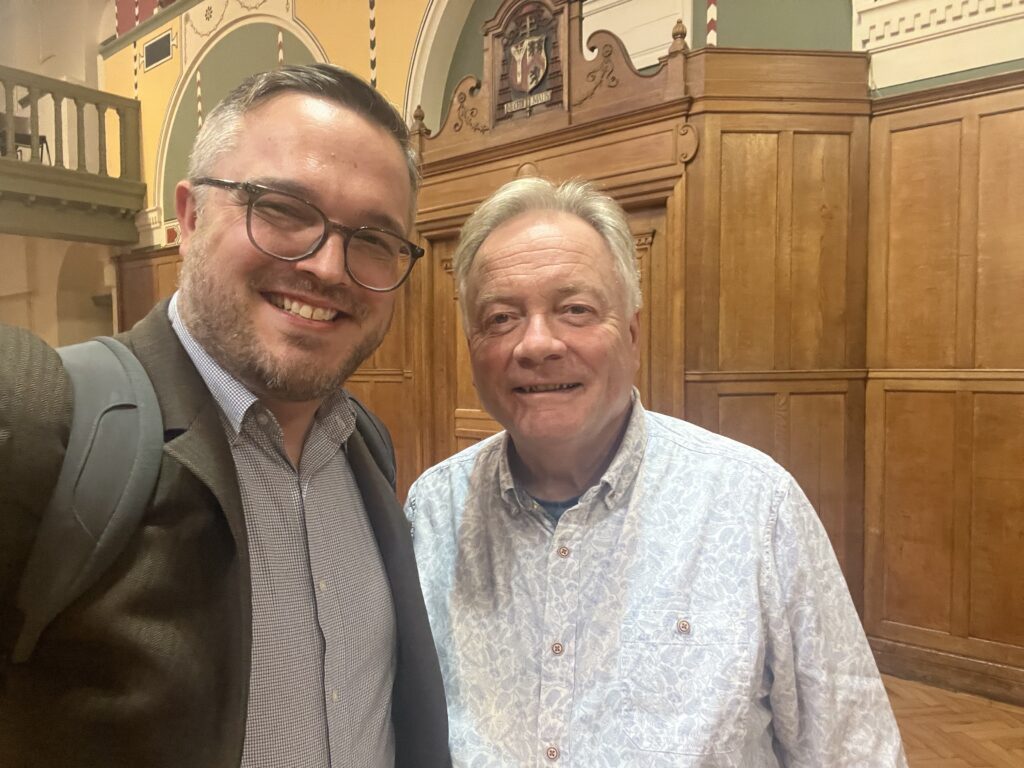
Garnet Singers conductor Nathan with his former mentor and the conductor of The Bach Choir, David Hill (photo by Nathan) [A selfie of the two conductors in the large rehearsal room The Bach Choir uses]
Leave a Reply